Customer interviews that ask why, in their language.
The go-to-market OS after the CRM era: ask real people, follow up on every answer, and decide where to launch and who to sell to first.
Free plan. No card.
A real interview
Teams that ran research with us


The problem
Go-to-market decisions run on thin evidence.
- 01
Surveys tell you what, not why.
A checkbox says 32% won’t buy. It doesn’t say what would change their mind.
- 02
Interviews don’t scale.
Recruiting, scheduling and moderating 30 interviews takes weeks, and usually in one language.
- 03
Bots answer surveys now.
In a 2025 study in PNAS, an AI agent passed 99.8% of the checks surveys use to catch bots.
Westwood, PNAS 2025
See it run
From one question to the reasons behind it.
- 01
You write the question.
Start from your own words. Run it as a survey, a voice interview or a focus group.
What’s the biggest factor influencing whether you enroll in the healthcare certification program? - 02
It asks why.
After each answer, the interviewer decides whether to follow up, up to five times per question.
What’s the biggest factor influencing whether you enroll in the healthcare certification program?The biggest factor is whether I can make the schedule and cost work with my job and childcare. If the classes are flexible and the payment plan is manageable, I’d be much more likely to enroll.Follow-upHow much flexibility would you need in the class schedule to make the program workable? - 03
Every answer is judged.
A separate model marks what each answer shows, such as a root cause or how likely they are to buy.
The biggest factor is whether I can make the schedule and cost work with my job and childcare. If the classes are flexible and the payment plan is manageable, I’d be much more likely to enroll.INTENT_HIGHFlexible evening or online classes with make-up options would significantly increase enrollment likelihood.
- 04
You read the reasons.
Answers are counted by reason, and each reason is backed by what people said.
How it works
One interviewer, three formats.
The same engine runs all three. It reads each answer and decides what to ask next, up to five follow-ups per question.
- Survey
- Your questions, plus open follow-ups where an answer needs one. Text, on any device.
- Voice interview
- One-on-one and spoken, in the respondent’s language. Every answer comes back as text you can search.
- AI focus group
- A moderated text room with several respondents. The AI keeps the topic and asks each person why.
Try it with your topic
Where conversations become data
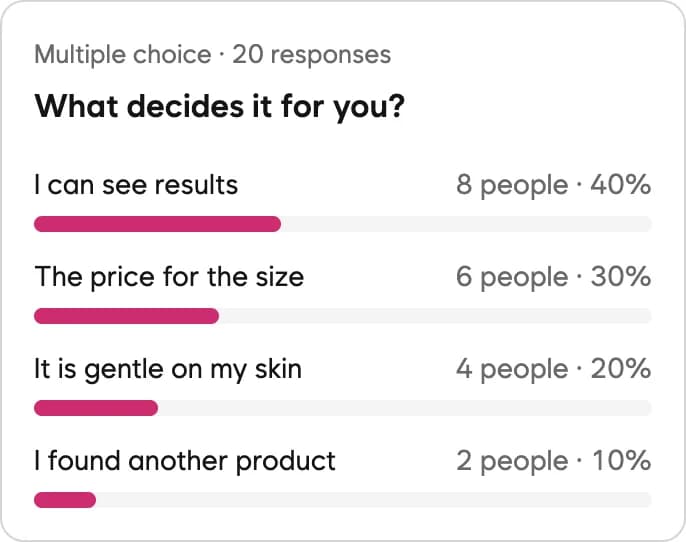
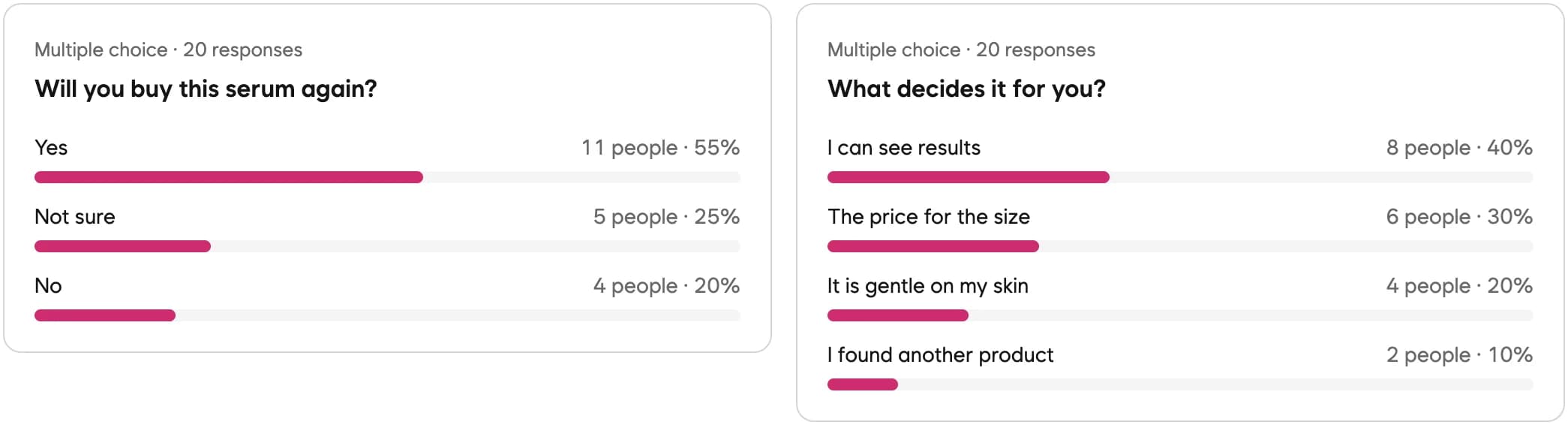
CURI AI counts every answer by reason. Under each reason, you read what customers said in their own words.
- I can see results8 of 20 · 40%
“My dark spots faded in about three weeks. That is why I keep buying it.”
- The price for the size6 of 20 · 30%
“It is good, but $38 for 30 ml runs out too fast.”
- It is gentle on my skin4 of 20 · 20%
“It does not sting, even on days my skin is red.”
- I found another product2 of 20 · 10%
“My sister gave me a cheaper serum that works about the same.”
Based on a sample of 20 interviews about a serum. The answers are synthetic. They do not come from a customer.
Why trust it
Answers you can defend.
Real people, recruited for your study
Invite your own customers, or we recruit through panel partners and paid social, screened against your criteria. We don’t sell synthetic respondents.
Every answer is read
A separate model reviews each answer and decides whether it needs a follow-up. Short or off-topic answers get one.
Your data stays yours
You own your respondents’ data. We process it on your behalf and don’t use it to train models.
Security, stated plainly
Our security program is built toward ISO/IEC 27001, ISO/IEC 27701 and Korea’s ISMS-P. We are not certified yet.
Use cases
What teams use it for.
Interviews in several countries at once
Run the same voice interview in each market’s language and compare the answers side by side.
Concept and price checks before launch
Test a concept or a price with real buyers, and hear why they would or would not pay.
Employee interviews
Talk to every employee one-on-one and in private, at the scale of a survey.
Recruiting in a new market
Screen people with a short survey, then invite the ones who qualify to the main study.
Voice intake
A voice agent takes a spoken request on your site and fills in the form for your team.
Daily voice check-ins
A short spoken conversation each day that tracks how someone is doing over time.
Cards show demo topics, not customer data.
Pricing
Start free. Upgrade when you need more.
Self-serve plans for teams that run their own studies. One unit is one text response; a voice interview is 20.
Free
Trying it out on your own
$0/mo
100 units a month
Starter
Small teams running a few studies a month
$149/mo
1,500 units a month
Growth
Teams asking across markets and languages
$499/mo
6,000 units a month
Scale
Organizations running Curi at scale under their own brand
$1,490/mo
20,000 units a month
USD card checkout opens soon. To start a paid plan in USD now, talk to us.
Enterprise
Managed studies, recruiting in your markets, invoicing and security review. From $20,000 a year.
FAQ
Questions
What is CURI AI?
A research platform that runs surveys, voice interviews and AI focus groups with real people. It asks a follow-up after each answer and counts the reasons behind what people say.
How is this different from a survey tool?
A survey asks only the questions you wrote. CURI AI asks those, then follows up on each answer, up to five times, so you get the reason and not just the choice.
Where do respondents come from?
Invite your own customers with a link, or ask us to recruit them through panel partners and paid social, screened against your criteria.
Which languages do you support?
Interviews run in the respondent’s language. Teams have run them in Korean, English and several European languages. Tell us your market and we will confirm.
Can I try it before paying?
Yes. The Free plan includes 100 units a month and every AI feature except AI focus groups. No card is needed.
Do you train AI models on our data?
No. You own your respondents’ data. We process it only to run your studies.